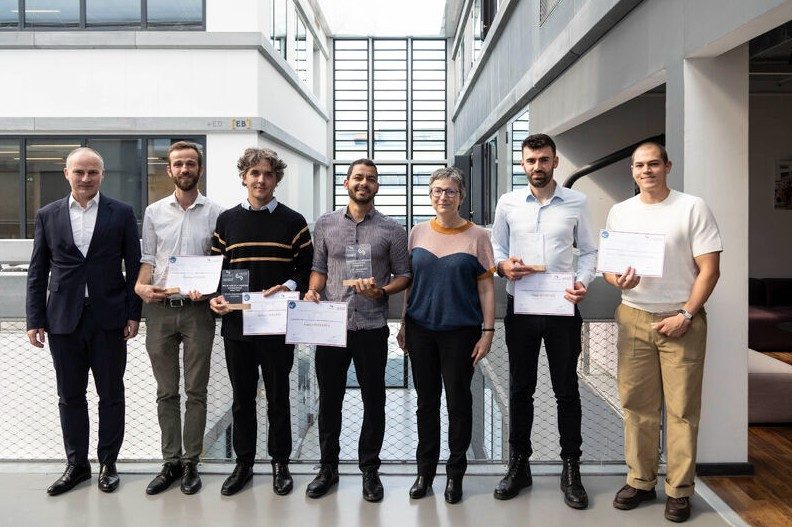


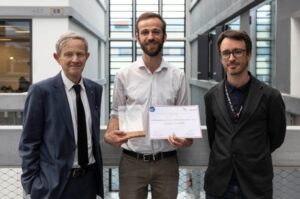
Through these awards, the Foundation is proud to support and promote outstanding research that helps advance science, innovation, and the major transitions our society is undergoing.
This year, the award-winning projects showcase the richness and diversity of the research conducted at CentraleSupélec: quantum technologies, additive manufacturing, superconductivity, hydrogen for the aerospace industry… all topics at the heart of tomorrow’s scientific and industrial challenges.
We extend our most sincere congratulations to the five award recipients and their thesis advisors for the remarkable quality of their work.
A big thank you also to our sponsors and donors, whose support enables the Foundation to foster research talent and contribute to CentraleSupélec’s scientific reputation.
Impact Science Category:
- The First Prize is awarded to Maël Bompaix for his work titled “Asymptotic Stability and Feedback Stabilization of Quantum Trajectories,” conducted at L2S—Laboratory of Signals and Systems—under the supervision of Nina H. Amini and Clément Pellegrini. The jury was particularly impressed by the elegance and originality of his work, whose methodological contributions are considered major advances in the study of quantum systems.
- The Second Prize is awarded to Juan Camilo Victoria Giraldo for his work titled “Modeling and Simulation of Ultrasound Diffusion Mechanisms in WLAM Components for Multiscale Characterization,” conducted at the Paris-Saclay Mechanics Laboratory under the supervision of Bing Tie, Alain Lhémery, Laurent Jérôme, and Denis Solas. The jury particularly appreciated the breadth of his contributions to the modeling and simulation of highly complex multiphysical processes in the context of additive manufacturing of materials.
Impact Innovation Category:
- The First Prize is awarded to Lauro Ferreira for his work titled “Toward Superconducting Railway Traction Substations: Transformer Development and System Integration,” conducted at GeePs —the Paris Laboratory of Electrical and Electronic Engineering—under the supervision of Loïc Quéval and Simon Meunier. The jury particularly appreciated the in-depth and systematic study of the use of high-critical-temperature superconducting materials in a real-world application: prototype design and fabrication, experimental validation, and a technical and economic analysis across various scenarios.
- The 2nd Prize is awarded jointly to Samuel Dillon for his work titled “Modeling and Simulation of H2/Air Combustion in Aeronautical Burners,” conducted under the supervision of Benoit Fiorina and Renaud Mercier, and to Nicolas Vaysse for his work titled “Stabilization and Dynamics of Hydrogen Flames in a Single-Injector Configuration and in an Annular Chamber,” conducted under the supervision of Ronan Vicquelin, Antoine Renaud, Daniel DUROX, and Sebastien Candel. Their very high-level theses conducted under the hashtag LabEM2C make major and complementary scientific contributions to hydrogen combustion for aeronautics, a key theme for the decarbonization of transport.